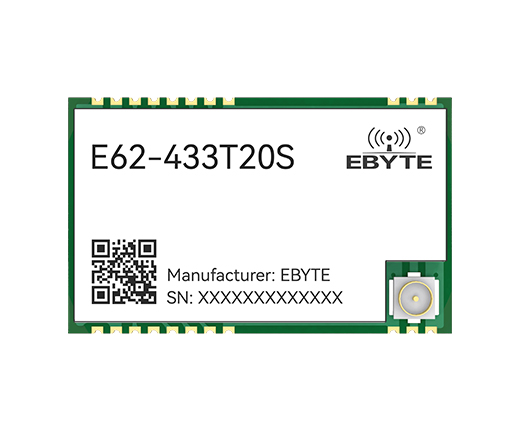
| Pin number |
Pin name |
Pin direction |
Pin usage |
| 1 |
RESET |
enter |
Module reset pin, 3.3V. |
| 2 |
GND |
– |
Module ground wire |
| 3 |
NC |
– |
Empty feet (not open for use, users do not need to care) |
| 4 |
NC |
– |
Empty feet (not open for use, users do not need to care) |
| 5 |
NC |
– |
Empty feet (not open for use, users do not need to care) |
| 6 |
NC |
– |
Empty feet (not open for use, users do not need to care) |
| 7 |
NC |
– |
Empty feet (not open for use, users do not need to care) |
| 8 |
GND |
– |
Module ground wire |
| 11 |
GND |
– |
Module ground wire |
| 12 |
ON |
output |
Antenna interface (high frequency signal output, 50 ohm characteristic impedance) |
| 13 |
GND |
– |
Module ground wire |
| 14 |
GND |
– |
Module ground wire |
| 15 |
GND |
– |
Module ground wire |
| 16 |
GND |
– |
Module ground wire |
| 19 |
GND |
– |
Module ground wire |
| 20 |
M0 |
Input (very weak pull-up) |
Cooperate with M1 to determine the two working modes of the module (cannot be left floating, can be grounded if not used) |
| 21 |
Lock |
output |
Module synchronization indication. A high level indicates that the two parties are synchronized and data transmission is possible; a low level indicates that the two parties are not synchronized. Transmitting data at this time will result in data loss. |
| 22 |
RXD |
enter |
TTL serial port input, connected to the external TXD output pin; |
| 23 |
TXD |
output |
TTL serial port output, connected to the external RXD output pin; |
| 24 |
TO |
output |
Used to indicate the working status of the module; the user wakes up the external MCU and outputs low level during power-on self-test initialization; (can be left floating) |
| 25 |
VCC |
– |
Module power supply positive reference, voltage range: 2.3~5.5V DC |
| 26 |
GND |
– |
Module ground wire |